When considering LED strips for your next project, it's crucial to understand your options. The decision often lies between COB and SMD LED strips. Both have unique features and benefits. According to lighting expert Dr. Emily Chen, “Choosing between COB and SMD LED strips is not just a matter of brightness; it’s about the application.”
What is the difference between COB and SMD LED strips? COB, or Chip-on-Board, offers a more uniform light output. This is due to multiple LED chips being packaged together, resulting in brighter and more efficient lighting. In contrast, SMD, or Surface-Mounted Device, provides flexibility. These strips are easier to install and can be cut to fit specific spaces.
In practical terms, COB strips are ideal for spaces requiring intense light, such as workshops or display cases. Meanwhile, SMD strips shine in home ambiance settings due to their versatility. As you weigh your options, consider your specific lighting needs. Both types present potential pitfalls. Consider the layout and power demands to make the best choice for your project.
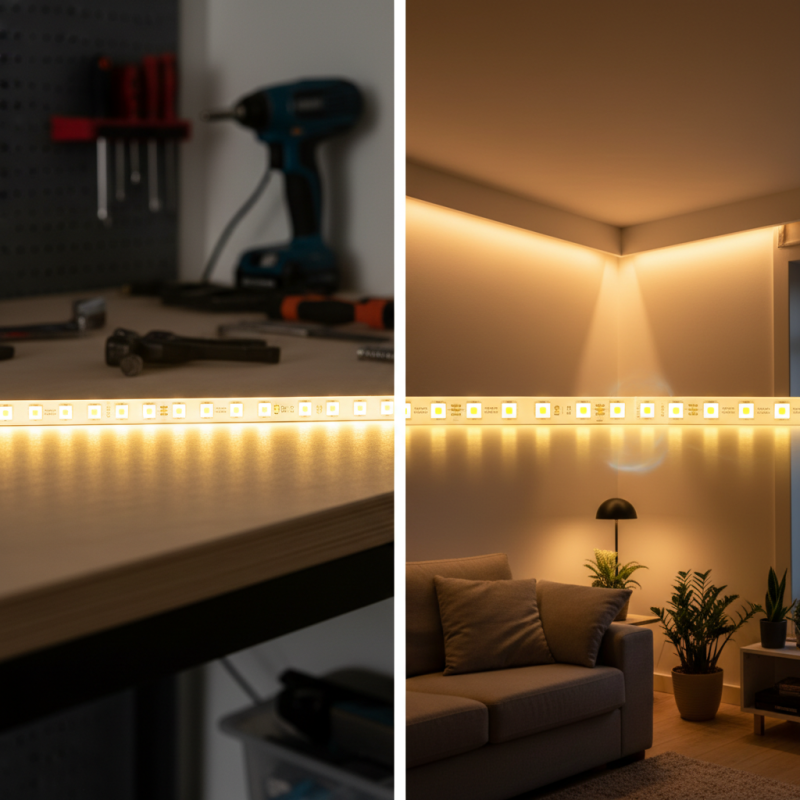
COB LED Strips: Definition and Key Features Explained
COB (Chip-on-Board) LED strips are gaining prominence due to their innovative design. Unlike traditional SMD (Surface-Mounted Device) LEDs, COB technology allows multiple chips to be placed closely together on a single board. This results in a more uniform light distribution and higher luminous output. According to a report by MarketsandMarkets, the COB LED market is expected to reach USD 8.73 billion by 2026, indicating a growing preference for this technology.
One key feature of COB LED strips is their energy efficiency. They typically use 20-30% less power compared to SMD strips, which can lead to significant energy savings over time. Additionally, COB LEDs tend to have a longer lifespan, often exceeding 50,000 hours. This longevity makes them a reliable choice for both residential and commercial applications. It’s worth noting that while COB strips offer excellent performance, they may not be as versatile as SMD strips in terms of color temperature options.
Tip: When selecting COB LED strips, consider the specific application. Are you using it for ambient lighting or task lighting? The right choice will enhance your space effectively. Another point to reflect on is the thermal management of COB strips. High intensity can lead to overheating, affecting performance. Ensure proper heat dissipation for optimal functionality.
Comparison of COB and SMD LED Strips
SMD LED Strips: Definition and Key Features Explained
SMD (Surface-Mounted Device) LED strips have transformed lighting solutions dramatically. These strips consist of small, individual LEDs mounted on a flexible circuit board. They offer a plethora of advantages, such as ease of installation and versatility in applications. They can be cut to different lengths, making customization straightforward. According to a report by the Energy Saving Trust, SMD LEDs consume up to 80% less energy than traditional lighting options.
These strips produce bright, uniform light, making them ideal for various settings, from residential to commercial. SMD technology allows for higher brightness levels while maintaining low heat output. This feature can enhance safety, especially in confined spaces. However, not all SMD strips are created equal. Some may have issues with color consistency and longevity. A study published in the Journal of Advanced Lighting Technology indicates that poor-quality SMD strips can fail prematurely, affecting both aesthetics and energy efficiency.
Overall, SMD LED strips provide numerous benefits, but caution is warranted in selection. Understanding their specifications can mitigate risks of quality variance. Selecting the right SMD strip requires attention to detail, including the LED density and lumens per watt. Researching reliable sources and reviews can aid in making the best choice for specific lighting needs.
2026 Best COB vs SMD LED Strips: Comparison Table
| Feature |
COB LED Strips |
SMD LED Strips |
| Light Emission |
Uniform illumination with no visible hotspots |
Spotlights visible, may have uneven lighting |
| Efficiency |
Higher efficiency, less power consumption |
Standard efficiency |
| Flexibility |
Limited flexibility, best for stable applications |
Highly flexible, suitable for various designs |
| Heat Management |
Better heat dissipation due to spread of chips |
May require additional cooling mechanisms |
| Cost |
Generally higher initial cost |
More affordable and widely available |
| Lifespan |
Longer lifespan with stable performance |
Decent lifespan but can degrade faster under high temperatures |
| Applications |
Ideal for commercial and high-end residential use |
Versatile for DIY projects and home lighting |
Comparative Analysis: Performance of COB vs SMD LED Strips
When comparing COB (Chip on Board) and SMD (Surface Mount Device) LED strips, performance is a critical factor. Studies show that COB technology offers better light density and uniformity. The 2022 Lighting Research Center report indicates that COB strips can achieve up to 110 lumens per watt, outperforming many SMD options which average around 80 lumens per watt. This significant difference makes COB ideal for applications requiring high brightness.
However, SMD strips hold advantages in flexibility and cost-effectiveness. Many projects may not require the high output of COB technology. SMD LEDs are often smaller, allowing for intricate designs. Also, industry reports indicate that SMD LED strips are generally less expensive to produce, making them accessible for budget-conscious projects. Yet, their lower efficiency can lead to higher energy costs over time.
It's also worth reflecting on heat dissipation. COB LEDs can produce noticeable heat, potentially leading to lifespan issues without proper management. On the other hand, SMD LEDs tend to operate cooler, reducing the risk of thermal failure. Determining the best choice ultimately depends on the specific application and desired outcomes.
Cost Considerations: Budgeting for COB vs SMD LED Strips
When considering LED strip lights, budgeting plays a vital role. COB (Chip on Board) and SMD (Surface Mounted Diode) LED strips have distinctive price ranges. Reports indicate that COB strips, while showing significant efficiency and brightness, can cost up to 30% more than SMD options. This difference in cost reflects their enhanced performance and durability.
But what about installation costs? SMD strips are generally easier to install, leading to lower labor expenses. Industry data suggests that installation costs for SMD can be reduced by 15% due to their flexibility and compatibility with various setups. This can influence overall budget planning significantly.
Tips: Always compare the total costs, including potential installation expenses. Sometimes, a cheaper product may lead to higher long-term expenses due to shorter lifespan or efficiency issues. Consider trying both types in a small project to assess their performance before making a large investment. Monitor your energy consumption with both strips; the efficiency differences could affect your utility bills over time.
Applications: Best Uses for COB and SMD LED Strips
When considering COB (Chip on Board) and SMD (Surface Mount Device) LED strips, their applications vary significantly. COB LED strips are known for their superior light output and uniformity. They are ideal for large, open spaces and applications requiring bright, consistent lighting. Reports indicate that COB technology can deliver up to 100 lumens per watt, making them energy-efficient. This is particularly beneficial in settings like galleries or display cases, where visual clarity is essential.
On the other hand, SMD LED strips offer flexibility and versatility. They are perfect for intricate installations and areas needing varied designs. SMD LEDs can fit into tight spaces, making them suitable for accent lighting in homes and businesses. Data shows that SMD configurations typically reach between 60 to 80 lumens per watt, which is satisfactory for most home applications. Additionally, their availability in multiple colors allows for creative designs, enhancing the aesthetic of any space.
However, it’s important to reflect on the limitations of both types. COB strips may generate heat quickly, requiring better thermal management. SMD strips, while flexible, might not achieve the same lumen output in one strip as a COB setup. Selecting the right strip depends on specific needs, balancing light output, heat management, and design flexibility.
FAQS
: SMD LED strips are flexible circuit boards with small, individual LEDs. They are easy to install and versatile.
SMD LEDs consume up to 80% less energy than traditional lighting. They help save on electricity costs.
They produce bright, uniform light and are customizable. Their low heat output enhances safety in tight spaces.
No, some may lack color consistency and longevity. Poor quality can lead to aesthetic and energy efficiency issues.
COB strips offer better light density and uniformity. SMD strips provide flexibility and are usually less expensive.
COB strips are suitable for large spaces needing bright and consistent lighting, like galleries and display cases.
Yes, SMD strips are perfect for intricate installations and fitting into tight spaces for accent lighting.
COB strips can generate significant heat, requiring effective thermal management to prolong their lifespan.
Look at the LED density, lumens per watt, and specific application needs to ensure effective lighting management.
Yes, researching reliable sources and reviews helps in making an informed choice and avoiding potential issues.
Conclusion
In the article "2026 Best COB vs SMD LED Strips: Which One to Choose?", the differences between COB (Chip-On-Board) and SMD (Surface-Mounted Device) LED strips are explored in depth. COB LED strips are known for their higher brightness and better heat dissipation due to the packaging of multiple diodes in a single module, resulting in a more uniform light output. In contrast, SMD LED strips are popular for their versatility and ease of installation, offering a wide range of color options and flexibility.
A comparative analysis reveals significant performance discrepancies, particularly in luminosity and efficiency. Budget considerations are also discussed, as COB strips often come at a higher upfront cost but can save money in the long run due to their longer lifespan. The article concludes by addressing the question, "What is the difference between COB and SMD LED strips?" and highlights the best applications for each type, guiding readers in choosing the right lighting solution for their needs.

 Zionsville Lighting