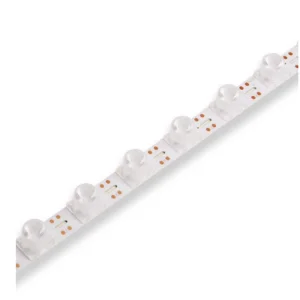
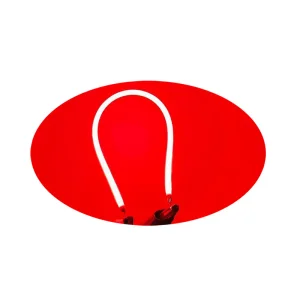
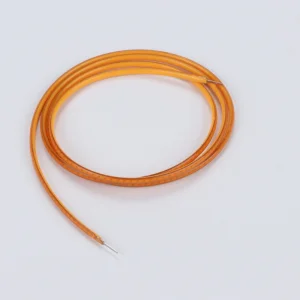
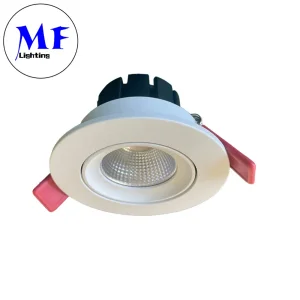
Direct factory distribution of certified solid-state lighting arrays, flexible filaments, and specialized signage subassemblies.
Established in 2011, Zhejiang Zionsville Lighting Co., Ltd. has grown to become a premium manufacturer and exporter of high-performance LED lighting modules, neon systems, and customized rigid LED configurations. Headquartered in China's manufacturing heartland, we serve the global lighting industry by bridging the gap between sophisticated optoelectronics design and scalable industrial-grade production.
Specializing in a comprehensive spectrum of luminaires—from high-density COB strips, flexible architectural neon solutions, to customized rigid LED arrays—Zionsville is synonymous with thermal efficiency, color fidelity, and structural integrity. Our products are fully certified with international safety and quality standards including ETL, TUV, CE, and RoHS, ensuring flawless compliance across demanding markets in North America, Western Europe, and Asia-Pacific.

The transition from conventional lighting to high-efficacy LED solutions has matured into a demand for highly reliable, specialized solid-state assemblies. Globally, the Rigid LED Module market is seeing exponential growth within architectural, industrial, commercial signage, and retail display sectors. Unlike flexible strip variants, rigid modules provide structural stability, exceptional thermal dissipation, and the precise mechanical positioning required for high-lumen density, narrow-tolerance applications.
In architectural and advertising displays, maintaining uniform luminance over large spatial layouts is a key engineering hurdle. Rigid modules, engineered on structural MCPCBs (Metal Core Printed Circuit Boards) or premium FR4 substrates, alleviate the performance limits common in flexible configurations. These systems allow for optimized heat dissipation paths, direct drive arrays without localized voltage drop, and integrated optics that generate uniform light distribution.
The industrial and commercial sectors are moving rapidly toward modularity, smart control compatibility, and spectral tailoring. Current industry developments include:
Highly skilled engineers deliver custom optoelectronic layouts, rapid prototype iterations, and new product series yearly to keep you ahead of shifting market trends.
Hundreds of LED configurations tailored for industrial, retail signage, and residential applications. OEM options include custom logo printing and bespoke packaging design.
In-house testing facility equipped for integrating sphere measurement, accelerated aging, high/low temperature chambers, water submersion, and electrical IES profiling.
Equipped with over 30 high-speed automated SMT lines, automated optical inspection (AOI), and packaging machines, ensuring high precision and rapid lead times.
100% optical and electrical testing before shipment. Pre-packaging burn-in screening eliminates potential infant mortality failures at the component level.
We support dynamic development lifecycles by offering free product samples, zero strict MOQ requirements on baseline designs, and stocked component buffers.
Selecting the correct substrate is crucial for achieving high electrical isolation and thermal performance in rigid LED configurations. At Zionsville, we analyze project parameters to recommend either high-performance FR4 or Metal Core PCBs (MCPCBs).
For industrial fixtures, edge-lit light boxes, and deep projection signage, LEDs are typically driven at high current densities. Standard FR4, composed of woven fiberglass sheets bound by epoxy resin, has a low thermal conductivity of roughly 0.25 W/m·K. This limited heat transfer can cause heat to build up around the LED junction.
To maintain safe junction temperatures under high loads, we construct our high-lumen rigid modules on Aluminum MCPCBs. These feature a dielectric isolation layer with thermal conductivities ranging from 1.5 W/m·K to 3.0 W/m·K, bonded to a solid aluminum backplate. This structure rapidly transfers heat away from the LED solder pads to external heatsinks, preventing thermal droop and ensuring consistent light output over time.
In architectural and retail applications, subtle shifts in color temperature across adjacent modules can disrupt visual uniformity. Zionsville maintains strict binning protocols to guarantee color consistency. We supply modules categorized within a 3-step MacAdam Ellipse (SDCM < 3) for architectural installations, and within a 5-step SDCM for general commercial signage. This precise color sorting ensures consistent correlated color temperatures (CCT) across large-scale, multi-stage projects.
The electrical design of a rigid board impacts its maximum run length and overall thermal performance:
Operating as a global manufacturer requires adapting designs to meet distinct regional installation practices and local environmental conditions.
Designed to comply with European Union Ecodesign requirements and energy labeling regulations. Our high-efficacy modules (exceeding 160 lm/W) feature integrated dimming systems (DALI/0-10V) to automatically scale back power consumption in response to ambient light levels.
For high-temperature environments in outdoor locations like Saudi Arabia or UAE, we utilize MCPCBs with thick thermal isolation layers. These are paired with high-transmittance silicone coatings (IP67/IP68 rating) to resist yellowing from intense UV exposure and prevent degradation from dust and thermal expansion.
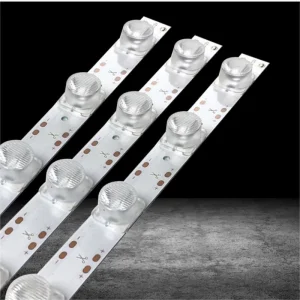
Engineered with custom narrow-beam optics (15° x 45° asymmetric distribution) to focus light across large, double-sided poster structures. This optical control ensures uniform brightness without hot spots or shadowing, even at shallow frame depths.
Beyond component manufacturing, Zionsville provides integrated lighting packages. We deliver pre-wired rigid arrays, customized wiring harnesses, matched MeanWell or Inventronics power supplies, and control systems. This comprehensive approach simplifies field installation, reduces component incompatibility issues, and accelerates project timelines.
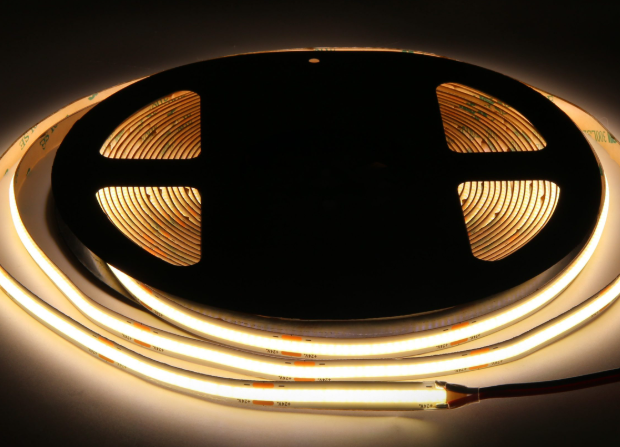
The solid-state lighting market is evolving from basic illumination toward smart, high-performance systems. Our technical development path centers on three core areas:
By mounting CSP LEDs directly onto rigid aluminum backplates, we can reduce the spacing between light sources. This design improves light extraction and lowers thermal resistance by removing traditional submounts, enabling high-brightness modules in more compact form factors.
We are integrating wireless protocols (such as Bluetooth Mesh, Zigbee, and Wi-Fi) directly onto the rigid substrate. This development enables individually addressable modules that support dynamic color changes, real-time power monitoring, and predictive maintenance diagnostics.
To meet global sustainability requirements, we are developing halogen-free substrates, using lead-free solder pastes with lower melting temperatures to reduce manufacturing energy, and designing modular fixtures that are easily disassembled for end-of-life recycling.
High-durability neon structures, constant current strips, and physical accessories for professional architectural configurations.
Expert technical answers regarding structural design, mechanical properties, and electrical systems.
 Zionsville Lighting